How to record specimen sightings
Here is how you can help develop a record of species seen in the wood to help with its future management

Recording your observations
When a visitor to the wood notes a particular specimen (be it insect, mammal, bird, plant, etc.) and can be reasonably certain of its identity, the usual wish is to pass the information on. The questions are ‘how’ and ‘to whom’.
If you are certain about the identity of your sighting please use one of the methods outlined below to record it.
If you are uncertain or need to make direct communication then please email a picture and comments to recording@bentleywood.info Be sure that your name, date of sighting and the location within the wood is clear.
What matters to the Trustees and all those who manage the wood is whether the data is accessible to them, both now and in future years. There are two routes which a record can go down and ideally it should traverse both.
The usual route is first to an ‘expert’ in the particular group who can verify the record. From that person it will be passed on to National databases and to the National Biodiversity Network.
The latter holds some 127 million records of species provided by 160 partners and this information is freely accessible to all, although it can take years before records finally reach this point. This fantastic resource is the source of a lot of the worrying data that we read so much about in the national media.
Ideally, the information is also passed back to more local databases such as that kept at the Wiltshire and Swindon Biological Records Centre which holds data for the county and can be accessed by the local planning authority and others with an interest in the ecology of an area.
The second route is a more direct one, to the owner of a site from which the record was made. To us, in Bentley, this is vital information which will help to inform management both now and in the future and there is one piece of software which performs this task (as well as the route above) particularly well. It is called Living Record and is a free, online facility for the entry of records by members of the public.
Your records are safe because only you and members of a small team of Bentley Wood recorders can review them. There are also safeguards concerning the level of detail provided for rare or vulnerable species, birds in particular.
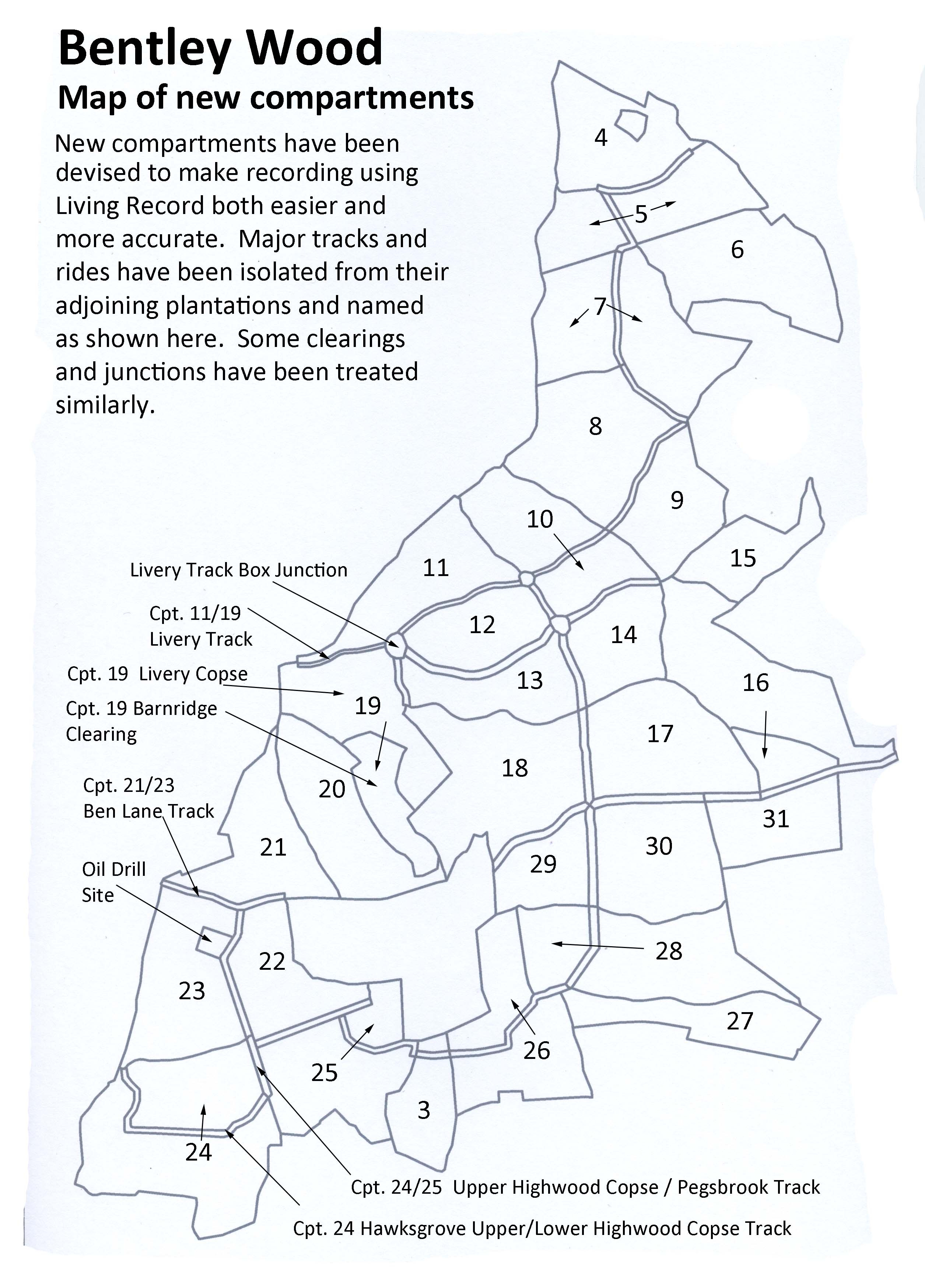
A powerful mapping tool allows members of our team to view maps of our records in a variety of ways. The most important practical aspect of this is when a specific area of the wood is due for management. The software has been customised such that the wood is divided into 71 different sections comprising the compartments, tracksides, clearings, ponds and other features.
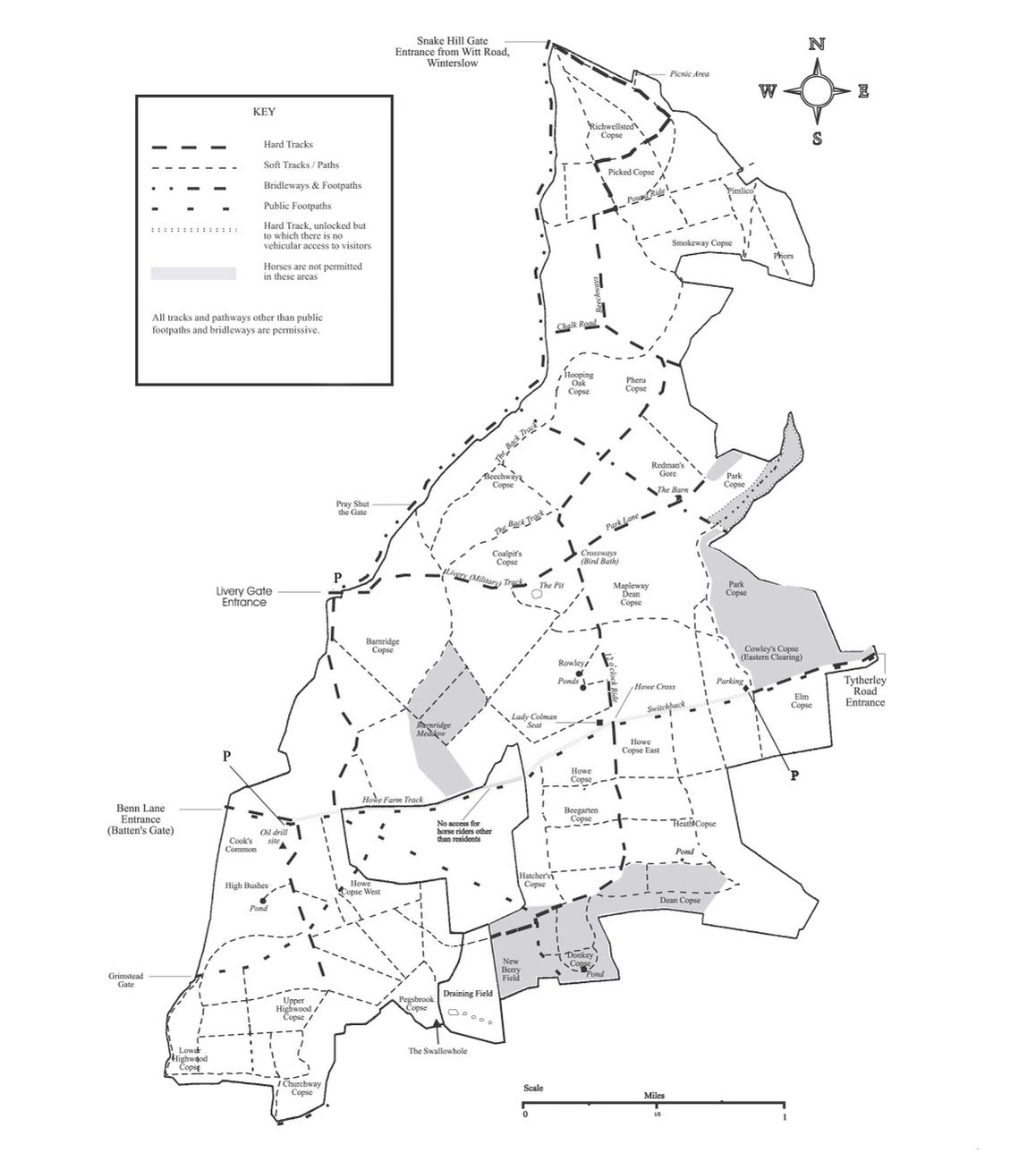
It is possible to obtain a species list for any one of these areas before decisions are made about tree thinning, felling, grazing etc. This level of detail depends on the quality of the original record; one which provides only ‘Bentley Wood’ as a location will not be as useful as one which states ‘Cpt. 23 or Hawksgrove Pond’. (See the reference maps showing copse names and their numbered compartments below.)
The value of the system also depends on the number of records entered and it is for this reason that the Trustees ask you to use this preferred system. We also have the capacity to input old records from different sources and incorporating these into the system.
During the 38 years that the wood has been owned by the Charitable Trust much has changed as it has progressed from a huge plantation of very young trees to a maturing woodland. The habitats have changed as the light reaching the ground has been limited by the growth of the trees and it is this progression that we hope our records will allow future trustees and managers to see and understand.
Some very interesting facts have been uncovered by looking at records made some years ago and you can read more about this in Phil Read’s interesting article on one historic archive. We need to ensure that records like this, as well as current information, are available for future reference.
Do please visit www.livingrecord.net and see how easy it is to use. Thank you.
Pat Woodruffe